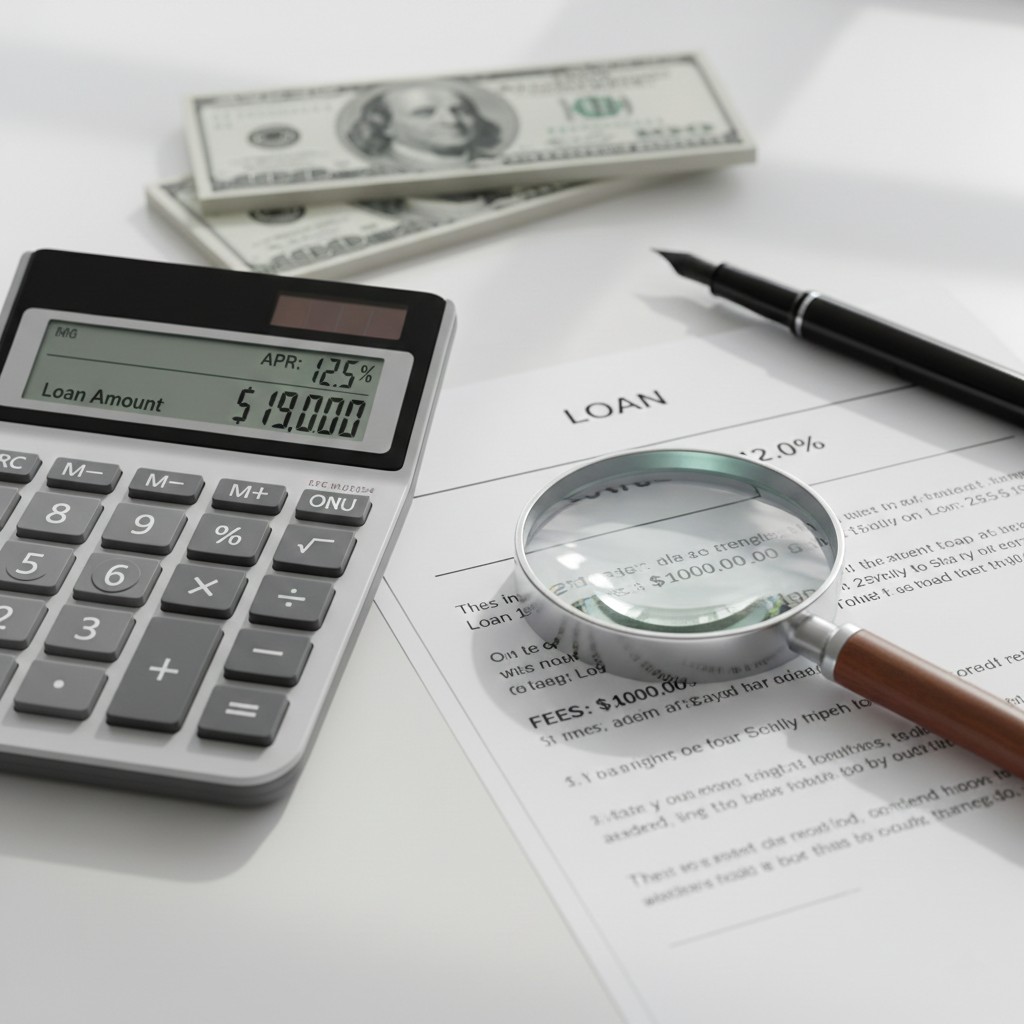
Picture this scenario: You have finally been approved for a $20,000 personal loan to renovate your kitchen. You did the math, the monthly payment fits your budget, and you signed the digital contract on Monday. On Wednesday, the notification pops up on your phone: “Deposit Received.”
You eagerly open your banking app, expecting to see $20,000. Instead, you see $19,200.
Panic sets in. Did the bank make a mistake? Did you get hacked? Where did the other $800 go?
Welcome to the most common surprise in the lending world: the Loan Origination Fee. As a loan underwriter who has processed thousands of applications, I can tell you that this fee is the single most misunderstood line item on a closing disclosure. In 2026, as lenders tighten their belts and rely more on automated risk pricing, understanding this fee is no longer optional—it is essential to ensuring you actually get the amount of money you need.
What Exactly is a Loan Origination Fee?
A loan origination fee is an upfront charge assessed by a lender for processing a new loan application. It is essentially the administrative price of doing business. It covers the cost of vetting your application, verifying your income, underwriting the risk, and processing the legal paperwork.
In the mortgage world, this is often called “points.” In the personal loan sector, it is simply the “origination fee.”
The 2026 Benchmark
In the current financial landscape, origination fees for personal loans typically range from 1% to 10% of the loan amount.
- Excellent Credit (760+): You might qualify for 0% to 1% fees.
- Average Credit (640-700): Expect fees between 4% and 6%.
- Fair/Poor Credit (<640): Lenders often charge the maximum 8% to 10% to offset the risk of default.
Many borrowers overlook this because they are too focused on the interest rate. But make no mistake: this fee is profit for the lender, and it comes directly out of your pocket.
The Math: How It Affects Your “Net Payout”
Here is the critical part that catches people off guard. Unlike a mortgage, where you might bring a check to the closing table to cover fees, personal loan origination fees are almost always deducted from the loan proceeds.
This means if you ask for $10,000 and the fee is 5%, you do not get $10,000. You get $9,500. However, you still pay interest on the full $10,000.
If you need a specific amount of cash—say, exactly $15,000 to pay a contractor—you must do the math backward and request a higher loan amount to cover the fee. You can use our Personal Loan Calculator to play with these numbers, but here is a simple breakdown of how much cash actually hits your account at different fee tiers.
Table: Loan Amount vs. Net Payout (The “Real” Cash)
| Loan Requested | Origination Fee % | Fee Amount (Lost Cash) | Net Payout (Cash to You) |
|---|---|---|---|
| $10,000 | 1% | $100 | $9,900 |
| $10,000 | 5% | $500 | $9,500 |
| $10,000 | 8% | $800 | $9,200 |
| $25,000 | 1% | $250 | $24,750 |
| $25,000 | 5% | $1,250 | $23,750 |
| $25,000 | 8% | $2,000 | $23,000 |
As you can see, on a larger loan with a high fee, you could lose $2,000 instantly. That is expensive money.
The Great Deception: Interest Rate vs. APR
This is where the marketing gets tricky. A lender might advertise a “Low Rate of 9%!” but hide a massive origination fee in the fine print.
This is why the APR (Annual Percentage Rate) exists.
- Interest Rate: The cost of borrowing the principal balance each year.
- APR: The total cost of the loan, including the interest rate PLUS the origination fee, expressed as a yearly percentage.
The APR regulations from the CFPB (Consumer Financial Protection Bureau) require lenders to disclose the APR so you can compare apples to apples.
Example:
- Loan A: 10% Interest Rate + $0 Origination Fee = 10% APR
- Loan B: 9% Interest Rate + 5% Origination Fee = ~12.5% APR
Even though Loan B has a lower “interest rate,” it is actually the more expensive loan because of the fee. Always compare the APR, not the headline rate.
What Determines Your Fee?
Why does your neighbor pay 1% while you pay 6%? Underwriting algorithms in 2026 weigh three main factors:
- Credit Score: This is the biggest driver. A higher score signals lower risk. If your score is lagging, I highly recommend you read our guide on how to boost your credit score before applying. Even a 20-point increase could drop your fee tier significantly.
- Loan Term: Shorter terms (3 years) generally carry lower risk—and lower fees—than longer terms (5-7 years).
- Income Stability: Lenders look for consistent cash flow to ensure you can pay back the loan without defaulting.
How to Avoid (or Reduce) Loan Origination Fees
The good news is that you don’t always have to pay this fee. The market is competitive, and you have options.
1. Shop “No-Fee” Lenders
Several premium lenders (often requiring good to excellent credit) have eliminated origination fees entirely to attract high-quality borrowers. Lenders like SoFi, LightStream, and Discover are known for this. You can find a curated list of these lenders in our review of Top-Rated Loan Platforms 2026.
2. Negotiate (Yes, You Can)
If you are dealing with a local credit union or a bank where you have a long-standing relationship, ask them to waive the fee. It doesn’t always work with online algorithms, but human loan officers often have the discretion to lower points to close a deal.
3. Do the “Break-Even” Analysis
Sometimes, paying a fee is worth it if the interest rate is low enough. If you plan to keep the loan for the full 5 years, a loan with a fee but a significantly lower interest rate might be cheaper in the long run than a “no-fee” loan with a higher interest rate. However, if you plan to pay the loan off early, the “no-fee” loan is almost always the winner because origination fees are non-refundable.
Conclusion
In 2026, the Loan Origination Fee is the gatekeeper to your funds. It can eat up a significant chunk of your proceeds if you aren’t paying attention.
Before you sign, ask two questions:
- “Is this fee deducted from my loan amount, and if so, what will my net deposit be?”
- “What is the APR compared to the interest rate?”
For more tools to manage your financial health, visit our library of Financial Resources. Don’t let the fine print cost you thousands—read the disclosure, run the math, and borrow smart.
Data Accuracy Note (2026): Market conditions, Federal Reserve interest rates, and lender algorithms change rapidly. While we strive to provide the most accurate insights as of January 2026, we recommend verifying all specific loan terms and APRs directly with your chosen platform before signing any agreement.